Buddhist activists appeal to Myanmar leaders, bring aid to fleeing victims

World Buddhist leaders are appealing for peace in Myanmar and Buddhist charities are bringing aid to victims fleeing the violence.

A Rohingya refugee family on the side of the road without shelter in Bangladesh Photo ©: UNCHR/Adam Dean.

Buddhist Global Relief, founded by one of the western world’s leading translators of the Buddha’s teachings, and the Tzu Chi (literally “Compassionate Relief”) Foundation, launched by a renowned Taiwanese Buddhist nun, are both dedicating relief resources to what UN Secretary General Antonio Guiterres has called “a humanitarian and human rights nightmare.”

The United Nations and major aid agencies now report that more than half a million people – mainly women, children and the elderly – have fled over the border between Myanmar (also known as Burma) and Bangladesh since late August. Thousands more continue to flood in every day. 

The exodus is the fastest exodus of human beings from a single country since the outbreak of the Rwandan genocide. The vast majority are members of Myanmar’s Muslim Rohingya, caught up in a violent conflagration that, according to the country’s security forces, includes official “cleansing operations”. The military said 176 out of 471 villages had been emptied of people, and an additional 34 villages “partially abandoned.”

Continue reading

Is Enlightened Society Possible?

Recently, in talks I have been giving, I have asked people  what they think an enlightened society would be like. Here are the students at Al Akhawayn University in Morocco  offering their thoughts.

Mindfulness and Public Policy

International legislators gather in London to contemplate mindfulness in politics

“I got thrown out of yoga for laughing,” UK government minister Tracey Couch told an international conference  of legislators exloring mindfulness and public policy. “So mindfulness as a means of helping me deal with my depression and anxiety was not something I thought was going to work.”
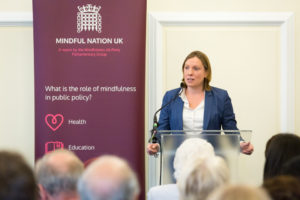
As Minister for Sport and Civil Society and a Conservative member of parliament, she was opening the first-ever international gathering of political leaders, educators, scientists, researchers and medical specialists to discuss “mindfulness in politics”. The event in London’s Westminster was attended by legislators from 15 nations, invited  by the nation’s All-Party Parliamentary Group on Mindfulness.

 ‘It really clicked”

“After attending my third session of training offered by the Mindfulness Group, I got it,” she said. “It really clicked. This is helping me: the understanding of who you are and how you can cope. Mindfulness teaches you to be in the present moment and not to be beating yourself up.”

Personal as her statement was, it was the opening of an event focused on public policy. “In fact,” said Dr Jon Kabat-Zinn, the molecular biologist described as the godfather of the contemporary mindfulness movement, “I always saw my work as a public health intervention.”
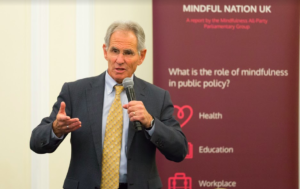
In 1979 Dr Kabat-Zinn founded the Mindfulness-Based Stress Reduction (MBSR) Clinic at the University of Massachusetts Medical School, and in 1995, opened the Center for Mindfulness in Medicine, Health Care, and Society. “When we started, there were no grants for mindfulness,” he told the conference. “Now there are scores of millions of dollars going into mindfulness research every year.”

“What we are learning from neuroscience now is that the brain is an organ of experience,” he said. “It is actually shape shifting, transforming itself on the basis of our experience from moment to moment. This is called functional connectivity or neuroplasticity. It’s been shown that in eight weeks of Mindfulness-Based Stress Reduction different regions of the brain get more dense. Other parts, like the amygdala which is the stress reactivity centre, actually reduce.”

The impact of the MBSR training on people suffering with depression was a key factor in bringing mindfulness to the attention of the British Parliament. Chris Ruane, Labour MP for the Welsh constituency of Clywd, broke the ground with an intervention in the House of Commons in 2012.
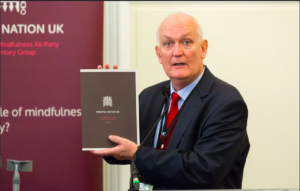
He presented research findings on the benefits of mindfulness training for people suffering from depression and dependency on prescription drugs. He called on the government to explore the application of mindfulness in health care and other public services, including those offering support to the unemployed.

Mindful Nation UK

 In the five years since Chris Ruane’s speech, the research has continued. With the formation of the All-Party Parliamentary Group on Mindfulness – and painstaking training of more than a hundred MPs, lords and civil servants – came the publication in 2015 of the group’s own research report Mindful Nation UK.

The parliamentarians’ report made policy recommendations for the practical application of mindfulness training in the areas of health care, education, the criminal justice system and the workplace.

At the London conference, an expert panel presented the results of efforts to implement the report’s recommendations. Hearing the results was one of the features that drew more than a hundred leaders and professionals in the fields of mindfulness and politics from around the world to the event. They came from countries as diverse as France and Sri Lanka, Croatia and Israel, the United States and Morocco.

“One billion people will suffer from depression at some point in their lifetime,” Willem Kuyken, Professor of Clinical Psychology and Director of the Oxford Mindfulness Centre, told the gathering. “The priority for health care systems around the world is going to be moving away from communicable diseases, dysentery and water-borne diseases to mental health. That’s a massive challenge we all face.”

A growing body of clinical research

There is a growing body of clinical research and practice that strongly suggests mindfulness training could be a key component in meeting that challenge. Dr Rebecca Crane, Director of the Centre for Mindfulness Research and Practice at Bangor University, Wales, described the development of a further mindfulness training system known as Mindfulness-Based Cognitive Therapy (MBCT). Integrating mindfulness with cognitive science, it is particularly designed for the needs of those suffering from depression.

 “We are still in the midst of the research,” she said. “In trials, MBCT halved the expected rate of relapse. There is increasing vulnerability with each episode of depression, and MBCT really supports people to reduce that vulnerability.” After further trials in 2004, The National Institute for Health and Care Excellence (NICE), recommended its use in the country’s National Health Service (NHS).”

Within only two years of the publication of the Mindful Nation UK report, two of its four recommendations for health policy are now being implemented. MBCT has become a “mandated” primary care intervention for psychological therapy services across England. This endorsement requires that it become widely available. The second policy success is that the NHS has agreed to fund the training of MBCT teachers for psychological therapy services. The teacher training will start in March 2018.

The impact of trauma and abuse

The Mindful Nation UK report also recommended that the NHS and the National Offender Management Service should work together to ensure the urgent implementation of NICE’s recommended Mindfulness-Based Cognitive Therapy (MBCT) for recurrent depression in the country’s prisons and parole system.

“The majority of people with whom we work face significant challenges, environmentally, psychologically and in relation to the impact that trauma and abuse have had on their personality formation,” said Amaladipa Remigio, Head of Public Protection for the National Probation Service in Wales. “This can result in behaviours that are harmful to themselves, to others and to society.”

“Levels of addiction and poor mental health are much higher than in the rest of the population, and incidents of violence, suicide and intentional self-injury have been at their highest recorded levels in the last 12 months. Recently, an offender was taking their own life every three days in British prisons,” she said to audible gasps from the conference.

In an attempt to find out if mindfulness training could be helpful, her service ran three experimental programs in high-risk offender hostels in Cardiff and Swansea, followed by a much larger research project designed in conjunction with Swansea University. It involved both offenders and probation officers and was conducted between January and October this year. “Mindfulness training is reducing stress levels, improving emotional self-management, creating a psychological space where more creative responses can develop and enhancing resilience, creativity and compassion,” Ms Remigio said.

“I’ve spent 24 out of the last 30 years in prison,” said Mark, a former offender released within the last year. He held the conference spellbound as he described his journey and his incessant mental turmoil. He described how, after attending his first mindfulness session, he went home, “did a short practice” before lying down on his bed and slept for what he said was the first time in those 30 years.

“Mindfulness has given me my life back,” he said. “I can walk down the street. I can stand here today. Believe me, for me this is a big, big deal. For a stubborn person like myself, if it can do it for me, then there’s an awful lot of other people in prisons today that could benefit from this.”

It is not only those who are incarcerated or on probation who are affected. Nicola, a probation officer, reported on the postive impact of mindfulness practice in what she called her “relentless” work, and Baroness Angela Harris spoke of the successful efforts to introduce mindfulness therapy into the units where British police receive trauma counselling and care.

Reflecting on the research data and testimonials, Dr Kabat-Zinn told the gathering, “I don’t think we realize the extent to which we are miraculous beings. Humans have this profound capacity for imagination, creativity and kindness even under very, very difficult circumstances.”

“Are you proposing an anti-politics?”

 “Mindfulness is about how we carry ourselves,” said Kabat-Zinn. “Carrying is the root meaning of the verb ‘to suffer’. We are carrying a lot of negativity, often a lot of anger and resentment. It weighs on us. But what if we learned how to carry things with a greater embrace of awareness? Yes, the circumstances outwardly would be the same as they always were, but inwardly we would have potentially new degrees of freedom in working with old and very, very knotty problems. We can modulate our behaviour. We can learn.”

“I wonder if you are proposing an anti-politics,” asked Alan Howarth, a Labour peer in the House of Lords, drawing a sustained round of applause. “During my political lifetime the dominant political ideologies have been about conflict and competition. Does this offer an antidote to the ideologies of conflict and competition? Or are you suggesting that politics is capable of being made humane?”

“Is the world, as we have constructed it, up to the task?” Kabat-Zinn asked in response. “It is getting more urgent to know the answer to that question. We are really talking about an orthogonal rotation in consciousness. The word means ‘rotated at ninety degrees’. Instead of running on auto-pilot until we are at each others’ throats, can we see with fresh eyes so that we are not using our science to destroy more and more people?”

“Maybe it starts with talking to people we don’t usually talk to. Mostly we are in an echo-chamber,” Kabat-Zinn replied. “We need to train ourselves in listening, so we become a stethoscope listening to the heart of the country.”

[The international conference, hosted by The Mindfulness Initiative, was held in London, October 2017.]


In the Midst of Hatred

Buddhist Humanitarian Project

Latest Update

Dear Friends of the Buddhist Humanitarian Project,

We have watched with growing alarm the worsening fighting in Myanmar. We are getting new reports of war crimes.

As a supporter of our work, we are writing to update you on these reports, to ensure that you are familiar with what we are doing and what is happening on the international level. We also want you to know how we intend to continue our efforts.

Long-standing conflicts have flared up, most recently in Rakhine State, where the Rohingya people have long lived peacefully alongside Rakhine Buddhists.

Having driven more than 800,000 Muslim Rohingya out of the country to Bangladesh, a conflict has now flared up between the Myanmar army and local Buddhists in Rakhine and Chin states.

 At the end of June, the military launched fresh “clearance operations” in Rakhine. Local Buddhist fighters, calling themselves the Arakan Army, are seeking autonomy from the central government. The military, which has been accused of stationing troops inside the area’s ancient Buddhist temples, is reported to have ordered 10,000 villagers out of their homes and ancestral lands.

A local council of Buddhist monks had already appealed to the authorities to stop the military from stationing soldiers at Thone Sat Tabone pagoda and opening fire from there. It is one of numerous temples built throughout the area over the centuries.

This month, Amnesty International issued a chilling report on the military operations. It said indiscriminate airstrikes were killing civilians, including children, and that these amounted to war crimes. “Despite mounting international pressure on the military’s operations in the area, including at the International Court of Justice, the shocking testimonies we have collected show just how deep impunity continues to run within Myanmar military ranks.”

Meanwhile, nearly 1,000,000 Rohingya people languish, stateless and vulnerable in the Cox’s Bazaar area of coastal Bangladesh. They are caged in the world’s largest refugee camps, where they fled nearly three years ago. These camps, an unimaginably crowded maze of tents and bare earth, is now under constant threat from the COVID-19 pandemic. There are cases in the camp, and great fear that it can, at any moment, burn through the population.

Our global appeals and work inside Myanmar

Since the beginning of this crisis, the Buddhist Humanitarian Project has helped organize several appeals to officials in Myanmar, to the US State Department, and to the United Nations. These appeals have been signed by hundreds of Buddhist teachers, monks, and practitioners, including some of the most prominent Buddhist figures in Asia and the West.

 In one of our efforts, we took out full-page advertisements in Myanmar’s leading newspapers. In our last appeal, a partner in Myanmar hand-delivered letters to leadership in Myanmar.

With the exception of a single response to one of us from the country’s monastic council, saying they were unable to meet us, we have heard nothing – although a number of us are in direct contact with courageous Buddhists, both monastics and laypeople. They are working to counteract inter-communal hatred and violence and to reach out to the Muslim minority throughout the country with gestures of peace, practical assistance and concern.

Our contribution, partnering with our sister Clear View Project, includes the underwriting of workshops in peacebuilding, communal harmony, and conflict reduction among various ethnic communities—a long, slow process that calls for patience and persistence.

 A number of our leading members have written about this crisis in major Buddhist magazines, calling for a response from the global community of practitioners.

In the US, we organized a speaking tour by Saffron Revolution monk Ashin Issariya from Wimoteti Thuka Monastery in Myanmar. For years, he has been outspoken in opposing the misrepresentation of the Buddha’s teachings by extremist monastics in his country. On his tour he visited Burmese communities in California, the Midwest, and Washington DC, and spoke at an all-day conference on the Rohingya crisis, hosted by the Boulder Shambhala Center

International developments

In December the UN General Assembly voted overwhelmingly to condemn human rights abuses against the Rohingya and other minorities, including arbitrary arrests, torture, rape and deaths in detention. The detailed resolution called on Myanmar’s government to take urgent measures to combat incitement of hatred against the Rohingya and other minorities in Rakhine, Kachin and Shan states. This was an important statement on the part of the international community, but action lags far behind. 

A month later the International Court of Justice voted unanimously to order Myanmar to take “all measures within its power” to prevent genocide. The panel of seventeen judges said the Rohingya still faced this threat. The justices ordered the Myanmar government to prevent killing and “causing serious bodily or mental harm” to members of the group, as well as preserve evidence of possible genocide that has already occurred.

The Buddhist Humanitarian Project: three directions

We at the Buddhist Humanitarian Project have assessed these developments, including the most recent dreadful news, and our experience of working in this crisis. We feel that our efforts are best spent in three directions:

1. Raising funds for direct relief of Rohingya communities in Bangladesh and inside Rakhine State.

2. Peacebuilding training in Rakhine State, and among Buddhist monastics across Myanmar.

3. Working for much more active efforts for peace in Myanmar on the part of governments around the world – including in the US where the current Senate and government have refused to take effective action.

The inspiration of the Buddha

We continue to draw inspiration from the life and teachings of the Buddha.

The Buddha’s teachings on peace and social harmony could not be clearer. (Please see Bhikkhu Bodhi’s anthology, The Buddha’s Teachings on Social and Communal Harmony.)

The life of the Buddha is also replete with examples. It is common throughout Asia to see paintings of the Buddha intervening to prevent war between two sets of his relatives, the Sakyans and the Kolyans, whose armies were massing on either side of the Rohini River. They had failed to resolve their dispute over the use of the waterway and were on the brink of armed conflict.

This crisis was brought to the attention of the Buddha and he thought to himself: “If I refrain from going to them, these people will destroy each other. It is clearly my duty to go to them.”

Some paintings depict him travelling through the sky and stopping in mid-air immediately above the middle of the river. His relatives seeing him peacefully sitting above them in the sky, are said to have laid aside their weapons and paid homage to him. The Buddha told them: “If I had not stopped you today, your blood would have been flowing like a river by now.”

Other images, like the one above, show him standing between the armies with his hand raised in the mudra of fearlessness.

 It is widely believed that it was at this time that the Buddha composed this verse, now well-known in the Dhammapada:

Among those who hate, happily to we live without hatred. In the presence of those filled with hatred, we dwell in their midst without hating.

We thank all of you, our good friends and supporters, for carrying this fearless message in your hearts at this time of great peril in our world.

In Peace,

Hozan Alan Senauke

Khin Mai Aung

Jill Jameson

Richard Reoch

Derek Pyle

Please feel free to share this letter with friends and members of your community.

May all beings be safe.

24 July 2020

Against hate speech and ethnic cleansing

“The Buddha would have helped those poor Muslims,” said His Holiness the Dalai Lama this past week as the world witnessed with horror the latest eruption of communal violence, terror and ethnic cleansing. This time it is in Myanmar (Burma).

Yet again a civilian population is bearing the brunt of the suffering. More that 400,000 people, mainly women and children, have fled killings and the burning of their villages. Another 150,000 are reported trapped in the mountains. They have been without food for two weeks and the pass they need to escape through has been mined by the military.

Photo: Channel 4 TV ” Exodus of Rohingya refugees from Myanmar”

The vast majority are members of the Muslim Rohingya community, described by the United Nations as “the most heavily persecuted ethnic group in the world.” Others, from the country’s Buddhist majority, are fleeing for shelter in the regional capital Sittwe.

A startling feature

A startling feature of this tragedy has been the inflammatory speeches of some of the Buddhist monks in the country. As in so many other conflicts those inciting violence have been a small, but vociferous, minority.

Continue reading